It took four horses, a stretch on foot and two men pulling sixteen-foot oars to get six visitors to Christmas dinner at Ocean Bay.
One of the visitors was expecting fish and potatoes.
The six had met at six o’clock on Christmas morning. The visitor who later wrote about it had accepted an invitation from a friend who had been to the bay before. He brought fishing tackle, a bathing suit, a gun and ammunition.
He called himself Holiday-Seeker. His story appeared in the Pelorus Guardian in January 1899, after a Christmas which he tells us fell on a Sunday.
They set off in a brake, a horse-drawn carriage, with four horses and a driver who knew his job. The road was another matter. Before they reached the cliffs near White’s Bay, it became so bad that several passengers had to get out and walk about two miles.
The boat waiting for them was called the Ocean Bay launch. Its power came from two men and those enormous oars.
They passed the empty cable station at White’s Bay, moved between rocks and passages, and came in sight of Robin Hood Bay, with its homestead among the trees. The visitor was enjoying the scenery. The boatmen were doing the work of getting him past it.
Beyond Robin Hood Bay they pulled into a sheltered nook for five minutes’ rest. Holiday-Seeker produced a bottle of Bass beer. The two men soon finished it.
Then they took up the oars again.
Another half-hour brought Ocean Bay into view, on the western side of the entrance to Port Underwood. The visitor described a bay about half a mile wide, with a fine sandy beach. At the landing they were met by Mr Aldridge senior, whom he introduced as a veteran whaler, and Mr and Mrs J. Aldridge.
There were handshakes all round and Christmas greetings. The visitors were taken to a new, comfortable house of about ten rooms.
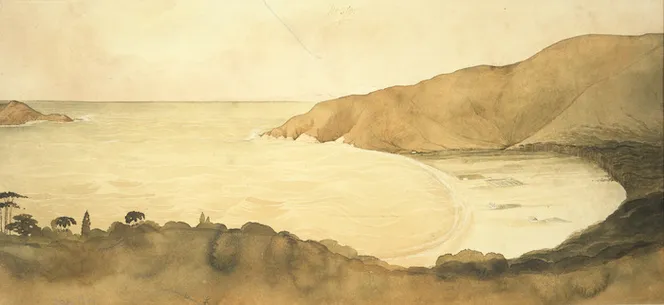
Catalogued as Ocean Bay, Port Underwood — William Fox, probably January 1848
The Alexander Turnbull Library identifies this watercolour as Ocean Bay. Its catalogue says the Ocean Bay inscription was added later, probably by someone other than Fox; the January 1848 date is inferred from his visit to Port Underwood. It is historical context, not a photograph of the Christmas party or proof of the identity of its house.
Fox, William, 1812-1893. Fox, William 1812-1893 :Ocean Bay [Port Underwood. January 1848?]. Ref: C-013-017. Alexander Turnbull Library, Wellington, New Zealand. View the original record: https://natlib.govt.nz/records/23216133.
Image unchanged. Noncommercial reproduction with full credit, under the Library’s stated conditions.
Then came dinner.
Roast geese, lamb, boiled ham and plenty of vegetables were set before them. There was pudding and pastry as well. The fish-and-potatoes expectation disappeared under a Christmas meal substantial enough for the whole party to pronounce it “kapai!”
The rest of Christmas Day was spent resting in the sun. Holiday-Seeker went to bed at ten. At six the following morning, rain beating on the roof woke him.
It kept coming until two in the afternoon.
When the clouds cleared, they went out after crayfish. They brought home about two sacks. The following morning he had a swim before breakfast, then joined a day’s fishing. They landed on an island for lunch and returned to Ocean Bay in time for tea.
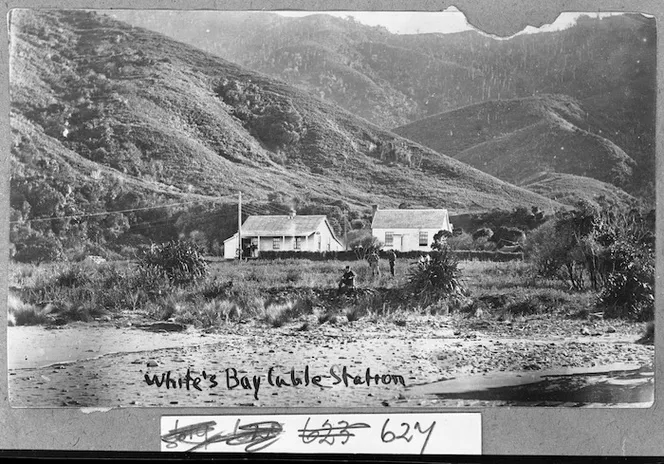
White’s Bay cable station, circa 1900s
The travellers passed the empty cable station on their way to Ocean Bay. This later photograph shows its coastal setting; the people pictured are not identified as the Christmas party.
Whites Bay cable station, Cloudy Bay, Marlborough. Making New Zealand: Negatives and prints from the Making New Zealand Centennial collection. Ref: MNZ-0627-1/4-F. Alexander Turnbull Library, Wellington, New Zealand. View the original record: https://natlib.govt.nz/records/23123675.
Photographer unidentified; catalogue date [190-?]. Image unchanged. Noncommercial reproduction with full credit, under the Library’s stated conditions.
The meals began to mark the days. Breakfast before the boat went out. Tea when it came back. After tea that evening, they planned an outing into the hills.
Three women and two men set off at ten in the morning to see a waterfall in the ranges behind Ocean Bay. One man carried a camera. Holiday-Seeker carried his gun, prepared, he explained, for possible encounters with wild pigs. The walk took three hours, over steep hills and through gorges, before they reached the water falling down an almost sheer rock face.
He reckoned the drop at about a hundred feet. The walkers thought it worth the climb. They gave the falls the name “Flo-Ive-Lillian”, and the man with the camera photographed them.
They left the falls at half past two. Another two hours brought them back. An early tea was ready, and apparently there was still enough energy left to try the crayfish again.
By now one of the women had learned enough about the boat and catching crayfish to take command. They expected a boatload. Hundreds could be seen on the rocks. According to their chronicler, they caught just two. They returned to the landing at dusk.
Their last full day took them out on the water again, with lunch at Point Robertson. There they were shown a site selected for a proposed lighthouse. Holiday-Seeker hoped the proposal would go further.
Then it was their final evening at Ocean Bay.
The next morning they gathered ferns and shrubs to take home. At one o’clock they said goodbye. Holiday-Seeker recorded how reluctant they were to leave, and before they embarked the party gave three hearty cheers for their host and hostess.
The boat took them back towards White’s Bay. The same four-horse carriage was waiting. Within two hours of climbing aboard it, they would be home, all of them, the writer said, feeling better for their holiday.
But at the beach they met another party, eight or ten people heading the other way.
The six were going home. The next visitors still had Ocean Bay ahead of them.
The story follows Holiday-Seeker’s contemporary account. Estimates such as the waterfall’s height remain his estimates. The accompanying pictures are separately dated; none is presented as a photograph of that Christmas party. The modern bay photograph shows nearby Kākāpō Bay, not Ocean Bay. The later residence record does not establish the identity of the ten-room house.
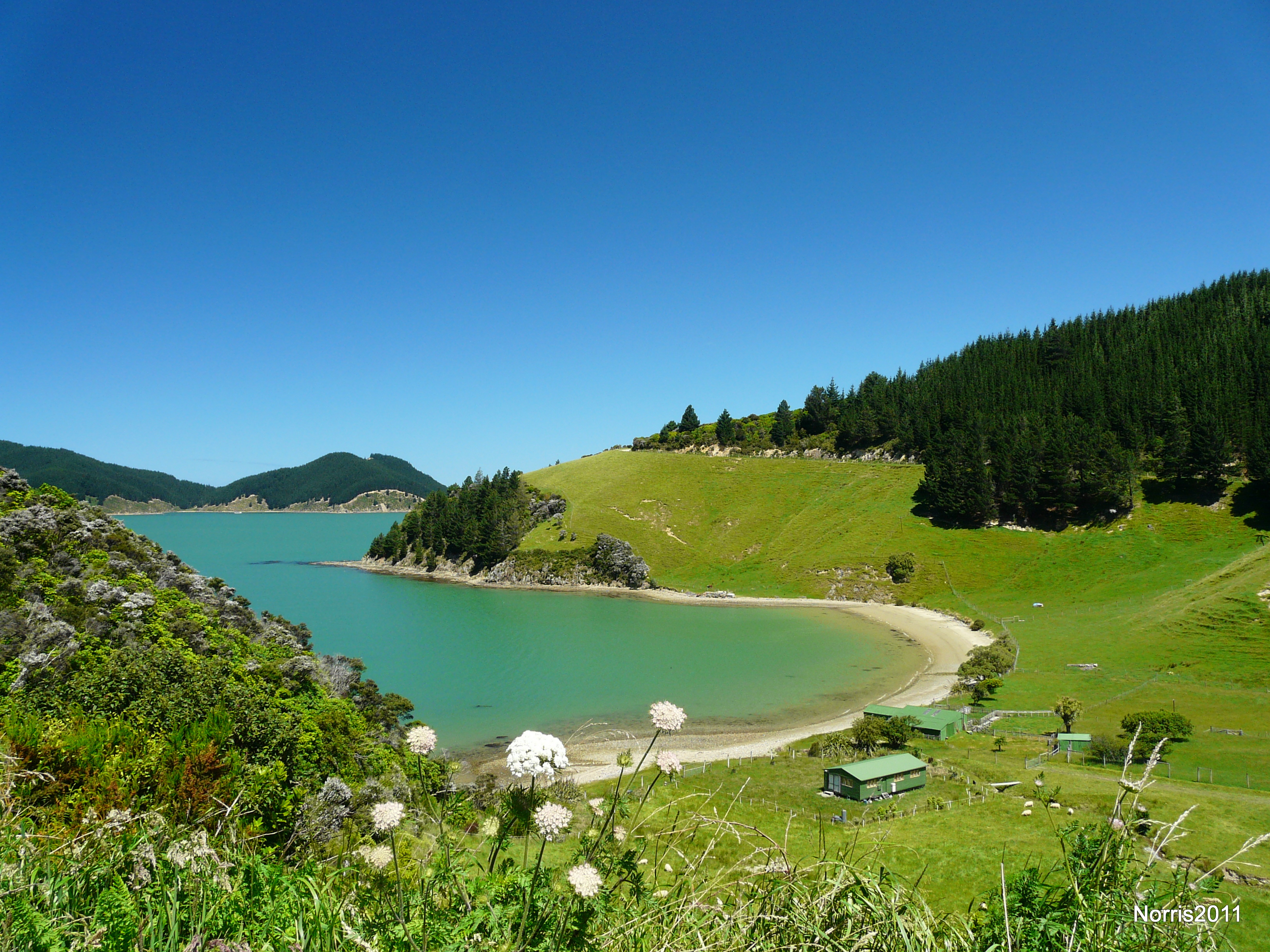
Kākāpō Bay, Port Underwood — photograph dated 28 November 2008 by the source
A view of Kākāpō Bay on the Port Underwood coast. The Christmas visit described in the story was to Ocean Bay, a different bay. No building in this photograph is identified here as the Aldridge house.
Photograph: grumpylumixuser, CC BY 3.0: https://creativecommons.org/licenses/by/3.0/, via Wikimedia Commons: https://commons.wikimedia.org/wiki/File:Ocean_Bay._On_the_Port_Underwood_road._-_panoramio.jpg.
The source filename says Ocean Bay, but the photograph shows Kākāpō Bay. Image unchanged, including its watermark. The date above is the source’s photograph date.
Geographic references: https://gazetteer.linz.govt.nz/place/24418 and https://gazetteer.linz.govt.nz/place/32965.
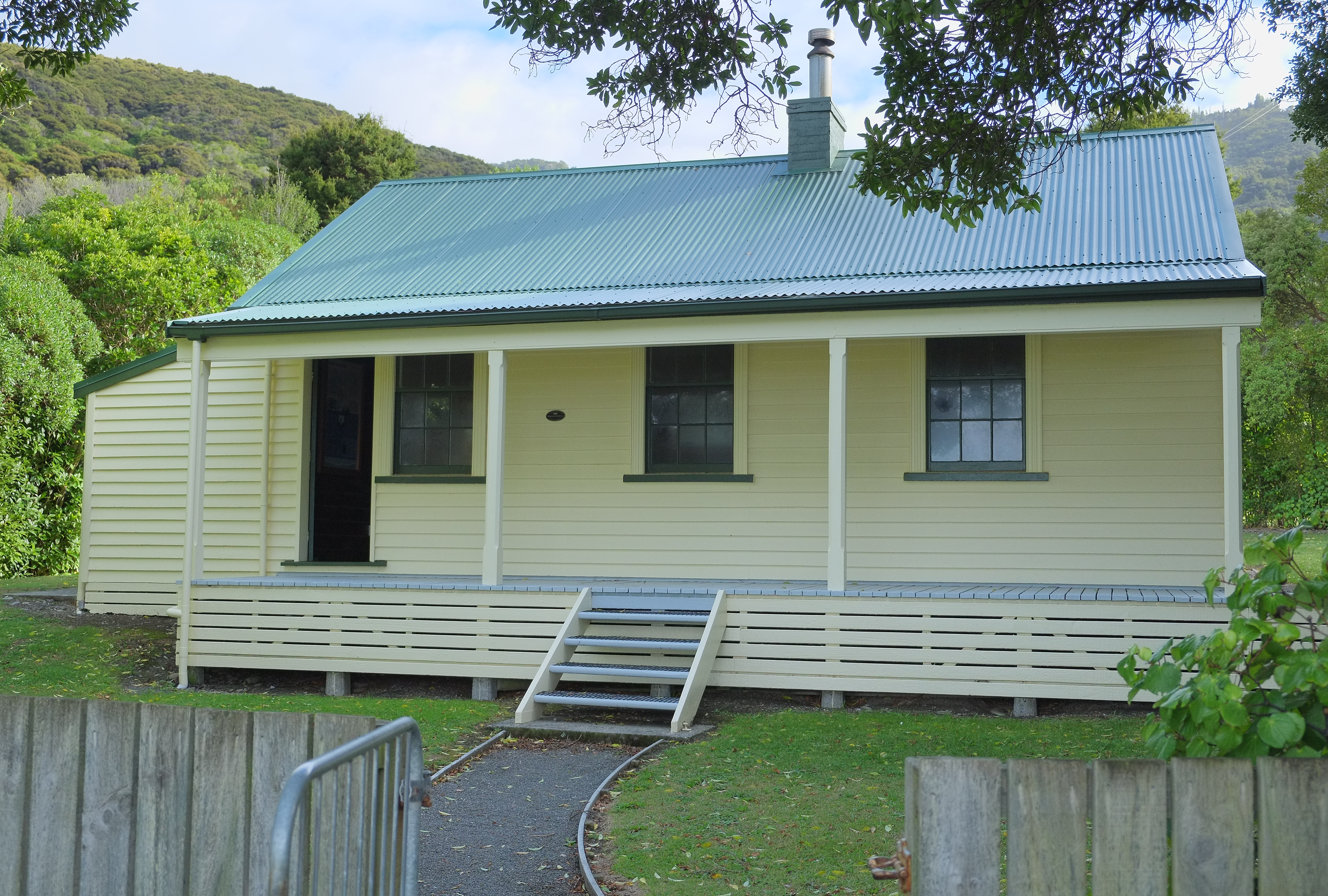
The surviving cable station, 3 April 2021
The station building at White’s Bay, photographed more than a century after the visitors passed the bay. It gives the older coastal photograph a recognisable point of comparison.
Photograph: Pseudopanax, public-domain dedication, via Wikimedia Commons: https://commons.wikimedia.org/wiki/File:Historic_Whites_Bay_telegraph_cable_station_building.jpg.
Image unchanged. This is the cable station, not the Aldridge home.